Understand your requirement
Start with actual bins, full loads, contents, permitted gripping features and the receiving opening. Define acceptable emptying, residual material and the complete production pattern.
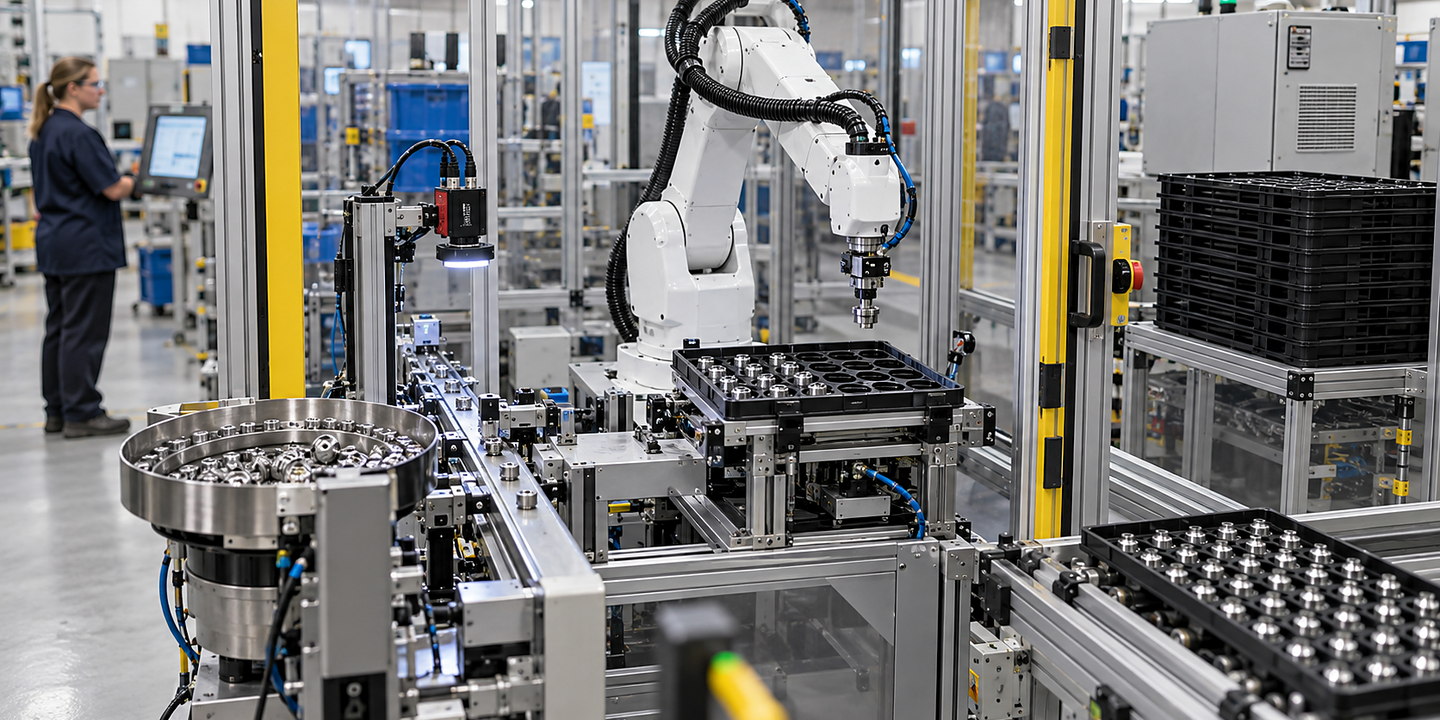
Compare robotic bin emptying, dedicated mechanical handling and operator-assisted arrangements using actual bins, discharge requirements and complete-cycle trials.
Compare robotic handling, dedicated mechanical arrangements and operator-assisted fixtures against the same bins, loads, contents and receiving process. Assess presentation, permitted gripping, discharge behaviour, emptying criteria, return handling and the recovery work included in each route.
Use the selection questions with the actual bin and interface brief. The choice needs evidence for complete accepted cycles and application-specific access and safeguarding review; the equipment category alone establishes no result.
Plan robotic bin emptying around your parts, process, cycle time, tooling, recovery and acceptance criteria. Discuss the highest-risk feasibility questions with Oxford Industrial Automation. When you compare solutions, check how each option handles part, product and process variation for robotic bin tipping & emptying, arrival pattern and presentation and your surrounding line.
Discuss your application

Start with actual bins, full loads, contents, permitted gripping features and the receiving opening. Define acceptable emptying, residual material and the complete production pattern.
Compare robotic, dedicated mechanical and operator-assisted routes using the same bin/load matrix and receiving task. Focus trials on uncertain gripping, discharge and recovery conditions.
Coordinate bin presentation, tipping movement, receiving equipment, services, control states and return handling. Include operator, cleaning and maintenance access in the application review.
Run agreed normal, uneven-load, incomplete-emptying and interruption cases. Retain accepted results and operator interventions, then define training, documentation and later-change responsibilities.
Typical support: feasibility study, sample trials, cell design, offline build, integration and production ramp-up.
| Approach | Often suitable when | Watch for |
|---|---|---|
| Robotic Bin Emptying | The required bin presentation, handling route and discharge task can be assessed together for the actual range. | Prove grip, movement, receiver interaction and completion; do not infer suitability from movement speed or one ideal load. |
| Purpose-Built Mechanical Automation for a Stable, Very High-Volume Task | A stable bin and receiving arrangement can be compared with dedicated lifting, tipping or transfer equipment. | Assess actual variation, residual material, access, maintenance and incomplete-cycle recovery under the same acceptance criteria. |
| Operator-Assisted Fixtures where Flexibility or Business Case Does Not Support a Robot Cell | Defined operator tasks and handling aids may suit the bin mix and operating pattern. | Assess the full load-handling arrangement, access, repeatability and workload; assistance alone does not establish safe handling. |